

Modern electrical installations require reliable protection against both electric shock and overcurrent faults. When selecting circuit protection devices, one of the most common questions is RCCB vs RCBO — which one should you choose?
Although both devices are designed to improve electrical safety, they serve different purposes and are suitable for different installation scenarios. Understanding these differences can help electrical distributors, panel builders, contractors, and brand owners choose the right solution for their projects.
In simple terms, an RCCB (Residual Current Circuit Breaker) protects against earth leakage currents, while an RCBO (Residual Current Circuit Breaker with Overcurrent Protection) combines earth leakage, overload, and short-circuit protection in a single device. The choice depends on factors such as installation design, available space, maintenance requirements, and project budget.
In this guide, we’ll explain the key differences between RCCBs and RCBOs, compare their advantages and limitations, and help you determine which solution is the better choice for different electrical applications.
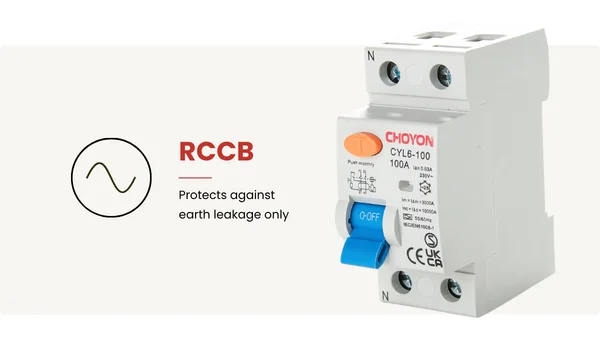
What Is an RCCB?
An RCCB protects against earth leakage currents but does not provide overcurrent protection.
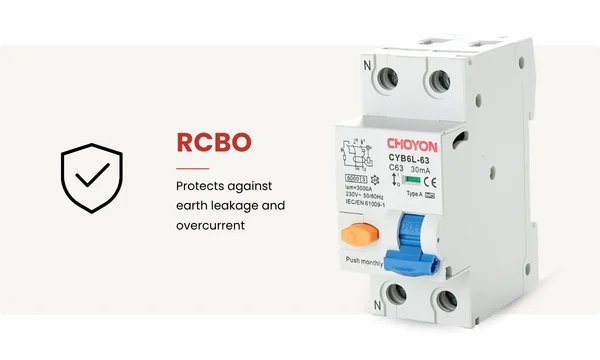
What Is an RCBO?
An RCCB protects against earth leakage currents but does not provide overcurrent protection.
RCCB vs RCBO Comparison
| Feature | RCCB | RCBO |
|---|---|---|
| Earth leakage protection | ✔ | ✔ |
| Overcurrent protection | Requires separate MCB | Built in |
| Devices per circuit | RCCB + MCB | One RCBO |
| Space required | More | Less |
| Initial cost | Lower | Higher |
| Fault isolation | Several circuits may be affected | Individual circuit |
| Maintenance | More devices to check | Easier fault finding |
| Best suited for | Multiple circuits and budget-focused projects | Independent circuit protection |
When Should You Choose RCCB?
- Tight budget
- Existing MCB installed
- Multiple circuits
- Large distribution boards
- RCCB + MCB preferred
When Should You Choose
RCBO?
- Independent protection needed
- Quick fault isolation
- Easy replacement
- Modern installations
- Residential projects
RCBO Advantages
- Individual circuit protection
- Easier maintenance
- Less wiring
- Saves installation space
- Ideal for modern systems
RCCB vs RCBO Comparison

FAQs
1. What is the main difference between RCCB and RCBO?
An RCCB protects against earth leakage currents only. An RCBO combines earth leakage, overload, and short-circuit protection in a single device.
2. Which is better, RCCB or RCBO?
Neither is universally better. RCCBs are more economical for protecting multiple circuits, while RCBOs provide individual protection and easier fault isolation for each circuit.
3. Does an RCCB need an MCB?
Yes. An RCCB does not provide overload or short-circuit protection, so it must be installed together with an MCB.
4. Why are RCBOs becoming more popular?
RCBOs simplify installation, improve fault isolation, save space, and meet the growing demand for individual circuit protection in modern electrical systems.
5. Should I choose RCCB or RCBO for a new installation?
For most modern residential and commercial installations, RCBOs are often the preferred choice. RCCB + MCB remains a practical solution when reducing initial cost is the main priority.
Conclusion
Choosing between an RCCB and an RCBO depends on your project requirements rather than which device is “better.”
If reducing initial cost and protecting multiple circuits are your priorities, an RCCB used together with MCBs remains a practical solution. If you need independent circuit protection, easier maintenance, and faster fault isolation, an RCBO is usually the better choice.
Understanding the differences helps you select the right protection solution for safer, more reliable, and more efficient electrical installations.

